
Chord Player
Chords with a full band.
Free · Works offline · No account


Chord Player
Chords with a full band.
Free · Works offline · No account
A chord player plays a sequence of chords back to you. Ours is free, runs in your browser with no sign-up, and a full band — drums, bass, piano, guitar and synth — plays your progression in 548 rhythms; export it as WAV or MIDI. A chord is a group of notes played at the same time, like pressing a few piano keys together so they ring out as one sound. Pick the chords, a speed and a style, then click and listen: no sheet music and no instrument needed.
Chord Sequence's chord player is a chord progression player as much as a chord finder: every chord you add can be shown on piano, guitar or ukulele, so you see how to play it while the band plays it.
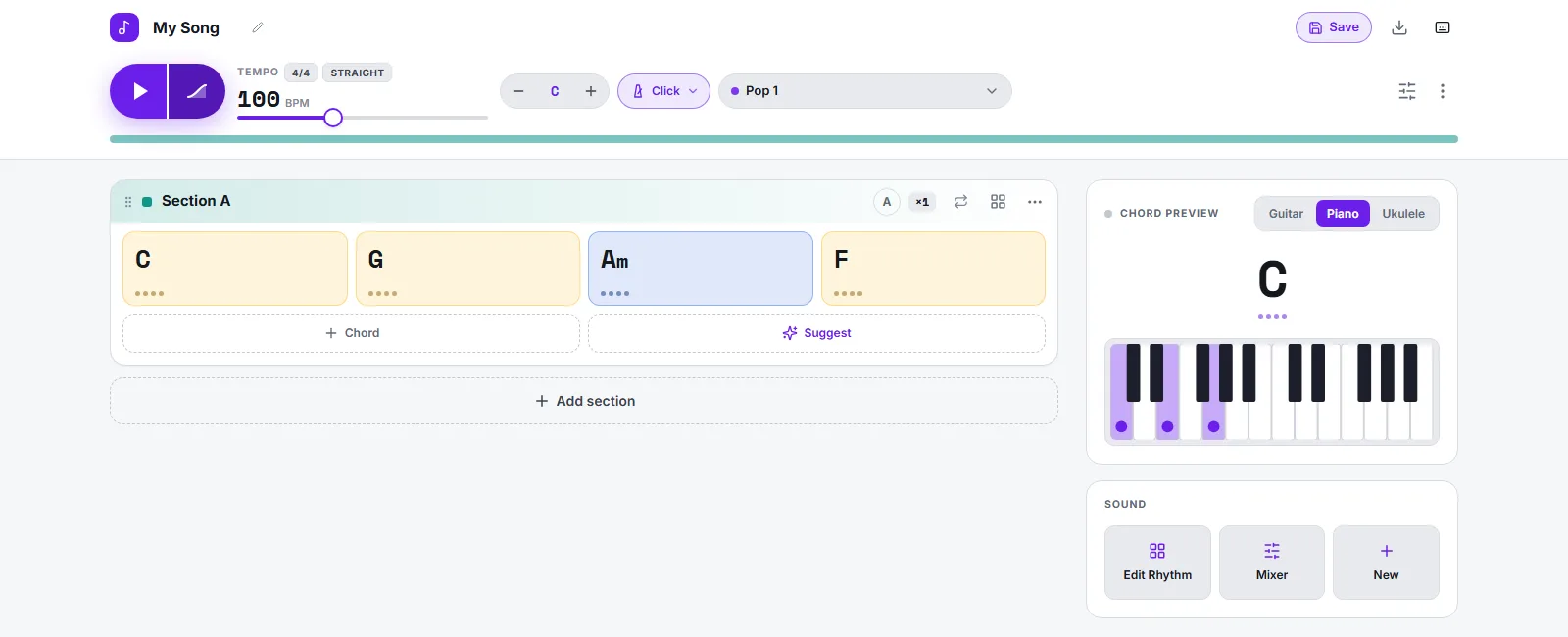
Pick a speed and a rhythm. There are 548, from pop and rock to salsa and reggae — each with its own drums, bass and chords, so the same progression feels completely different.
Add your chords. Add Chord one at a time, Suggest for progressions real songs use — or a random one, and let the tool surprise you.
Arrange them. Drag any chord to reorder or remove it. Group them into parts with Add Section — like a verse and a chorus.
Loop a section. Hit Loop on any section to keep just that part playing while you work on it.
Not sure where to begin? Open one of the progressions songs are built on, in C, with a rhythm that suits it — then change the key, the tempo or the style and make it yours.
Each section plays the rhythm's Intro, A, B or Ending. Tap the letter on a section to choose.
Every part step by step for drums, piano, guitar, bass and synth, each with its own sound, plus a Fill. New builds one from scratch.
Volume, pan, mute and solo for each instrument, with its own EQ and compressor, and reverb for the whole mix.
Give a section a rhythm of its own, or switch any instrument off for it.
Shift every chord up or down at once, no retyping.
Every chord can show its guitar shape while the band plays it, so you see where the fingers go as you hear it. Give the guitar an acoustic, nylon or clean electric sound, recorded or sampled, and edit its strumming step by step. Ukulele shapes too.
Show any chord as piano keys instead, and play it on a grand piano, an electric piano, a Rhodes or an organ. Slash chords such as C/E keep their bass note, on the keys and in the band.
Write the progression once and hear it loop: in sections like a verse and a chorus, in any of 548 rhythms, at any tempo, in any key. Loop just the section you are practising, then export the whole song as WAV or MIDI.
Keeps your song in your library, ready to share by link. Free account required.
A real audio file of your song, or its notes for your DAW.
Use it to find a new chord pattern for a song you're writing, make a backing track to sing or play along with, or just try the same chords in a different style — like turning a slow pop song into a fast rock one — before deciding which version you like best.
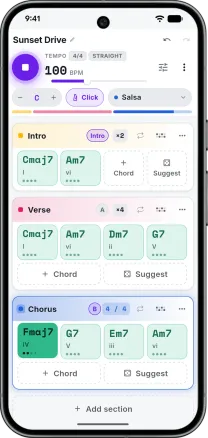
Practising on your phone? The same player, with the same rhythms and sounds, is also a backing track app for iPhone and Android that works offline.
No — you can build, play and export a song without signing up. An account is only needed to keep songs in your library and share them by link.
Yes. Every feature is free, including downloading your song as a WAV or MIDI file. No paywall, no limit on how much you can make.
Yes — Edit Rhythm picks the sound of each instrument (the drum kit, piano, guitar, bass and synth) for every part of the rhythm, and the Mixer mutes, solos and levels any of them.
Yes — every chord can be shown as piano keys, a guitar shape or a ukulele shape, so the same player works as a guitar chord player and a piano chord player.
Yes — Export WAV turns your song into a real sound file, at whatever speed and rhythm you last had it set to, and Export MIDI gives you the notes to open in any DAW.
Need inspiration? Browse chord progressions by genre →