Chord Progressions
A chord progression — or chord sequence — is a series of chords played in order. These 11 are the ones most songs are built on. Choose a key, read them as chords, numbers or Do Re Mi, and press play to hear each one with a full band.
- Progressions
- 11
- Keys
- 12
- Songs analysed
- 95
25 of the 95 songs on Chord Sequence use the I–V–vi–IV loop somewhere — more than any other progression. Open any row to see which.
Pop, rock and worship staples
Diatonic loops of three or four chords. Most of the songs on this site are built on one of them.
- 01
I–V–vi–IV (1–5–6–4)
Axis (four-chord song)Uplifting, anthemic
CGAmFStarts at home, rises to the V, dips to the relative minor and lands on IV, which leans back to the I as the loop restarts. Every chord belongs to the key, so a melody sits comfortably over all four: it is the loop under countless pop choruses and modern worship songs.
Heard in: Let It Be — The Beatles · Someone Like You — Adele · I'm Yours — Jason Mraz
In 25 of our 95 songs: Build My Life, Oceans (Where Feet May Fail), Counting My Blessings and 22 more
- 02
vi–IV–I–V (6–4–1–5)
Sensitive (minor start)Emotional, reflective
AmFCGThe Axis loop started on its minor chord. Beginning on vi makes the same four chords sound reflective instead of triumphant. Heard from A minor it is i–VI–III–VII, the dark minor loop of film scores, rock and trap.
Heard in: Zombie — The Cranberries
In 26 of our 95 songs: Build My Life, Oceans (Where Feet May Fail), Counting My Blessings and 23 more
- 03
I–vi–IV–V (1–6–4–5)
'50s / doo-wopNostalgic, warm
CAmFGThe doo-wop changes of the 1950s: home, its relative minor, then IV and V. Ending on the V leaves each pass on a question that the next I answers, which is why it loops so naturally.
Heard in: Stand by Me — Ben E. King · Every Breath You Take — The Police
In 12 of our 95 songs: Build My Life, 10,000 Reasons (Bless the Lord), Holy Forever and 9 more
- 04
I–IV–vi–V (1–4–6–5)
Worship liftHopeful, building
CFAmGSteps away to IV, sinks to the vi and climbs through the V, so every pass ends with a lift back into the I. The rising vi–V–I at its end is a staple of contemporary worship choruses.
In 11 of our 95 songs: King of Kings, WASHED, Our God Reigns and 8 more
- 05
I–IV–V (1–4–5)
Three-chord trickDirect, bright
CFGThe three major chords of a key: home, the step away and the dominant that pulls back home. With these three alone you can play most folk, country and early rock and roll, and the 12-bar blues is built on them.
Heard in: La Bamba — Ritchie Valens · Twist and Shout — The Beatles
In 25 of our 95 songs: What A God, Counting My Blessings, To Worship You I Live and 22 more
- 06
I–♭VII–IV (1–♭7–4)
Mixolydian rockOpen, rocking
CB♭FBorrows the ♭VII from the Mixolydian mode, so the loop never touches the leading tone and never quite resolves. The result sounds open and rocking rather than settled: classic rock's favourite move.
Heard in: Sweet Child O' Mine — Guns N' Roses · Sympathy for the Devil — The Rolling Stones
In 2 of our 95 songs: Owe You Praise (feat. Chandler Moore), Always On Time
- 07
I–V–vi–iii–IV–I–IV–V (1–5–6–3–4–1–4–5)
Pachelbel’s CanonMajestic, timeless
CGAmEmFCFGPachelbel's eight-chord ground: its bass falls a fourth and rises a step, over and over, so the harmony keeps moving without ever leaving the key. That steady motion suits long melodies that build.
Heard in: Canon in D — Pachelbel
Jazz and blues
Sevenths and dominant movement: the cadence every standard leans on, and the form under most of rock and roll.
- 08
ii7–V7–Imaj7 (2–5–1)
ii–V–ISmooth, resolved
Dm7G7Cmaj7The strongest cadence in tonal harmony: the ii prepares the V, and the V7 resolves into the I. Jazz standards chain it through key after key; with plain triads it closes countless pop and worship phrases too.
Heard in: Autumn Leaves
In 9 of our 95 songs: To Worship You I Live, You Are The One, Heart Of Worship and 6 more
- 09
I7 ×4 · IV7 ×2 · I7 ×2 · V7 · IV7 · I7 · V7 (1–4–5 (12 bars))
12-bar bluesGritty, swinging
C7C7C7C7F7F7C7C7G7F7C7G7Twelve bars on the I, IV and V, all played as dominant sevenths: four bars of I, two of IV, two of I, then V, IV, I and a turnaround on V. It is the form of the blues and of early rock and roll.
Heard in: Johnny B. Goode — Chuck Berry · Pride and Joy — Stevie Ray Vaughan
Minor, modal and cinematic
Borrowed chords and descending basses for drama, longing and tension.
- 10
i–VII–VI–V (1m–7–6–5)
Andalusian cadenceDramatic, Spanish · in Am
AmGFEA minor key walking down by step to a major V. The descending bass and the major chord at the bottom give it its Spanish, flamenco colour, and the V pulls straight back to the i, so it loops.
Heard in: Hit the Road Jack — Ray Charles · Runaway — Del Shannon
- 11
IV–V–iii–vi (4–5–3–6)
Royal RoadBittersweet, yearning
FGEmAmClimbs from IV to V and then, instead of resolving home, drops to iii and vi. Avoiding the I keeps it yearning. It is so common in Japanese pop that its name is Japanese: ōdō shinkō, the royal road progression.
In 2 of our 95 songs: Dame de beber, Firm Foundation (He Won't)
Chord Player
Build your own progression
Start from any of these loops in your key, then change chords, add a verse and a chorus, pick a rhythm and play it with drums, bass and keys. Free, no account needed to start.
- · Swap any chord from the chords of the key
- · Rhythms for pop, rock, gospel, R&B, jazz, Latin and more
- · Export to MIDI or WAV for your DAW
How songs are counted: a song uses a progression when its chords, read as degrees of the song's key, follow it in order inside one section. 95 published songs, updated 2026-11-09.
The chords in every key
Every progression above is built from these seven chords. Amber chords are major, blue minor, purple diminished.
| Key | I Major | ii Minor | iii Minor | IV Major | V Major | vi Minor | vii° Diminished |
|---|---|---|---|---|---|---|---|
| C | C | Dm | Em | F | G | Am | B° |
| D♭ | D♭ | E♭m | Fm | G♭ | A♭ | B♭m | C° |
| D | D | Em | F♯m | G | A | Bm | C♯° |
| E♭ | E♭ | Fm | Gm | A♭ | B♭ | Cm | D° |
| E | E | F♯m | G♯m | A | B | C♯m | D♯° |
| F | F | Gm | Am | B♭ | C | Dm | E° |
| F♯ | F♯ | G♯m | A♯m | B | C♯ | D♯m | E♯° |
| G | G | Am | Bm | C | D | Em | F♯° |
| A♭ | A♭ | B♭m | Cm | D♭ | E♭ | Fm | G° |
| A | A | Bm | C♯m | D | E | F♯m | G♯° |
| B♭ | B♭ | Cm | Dm | E♭ | F | Gm | A° |
| B | B | C♯m | D♯m | E | F♯ | G♯m | A♯° |
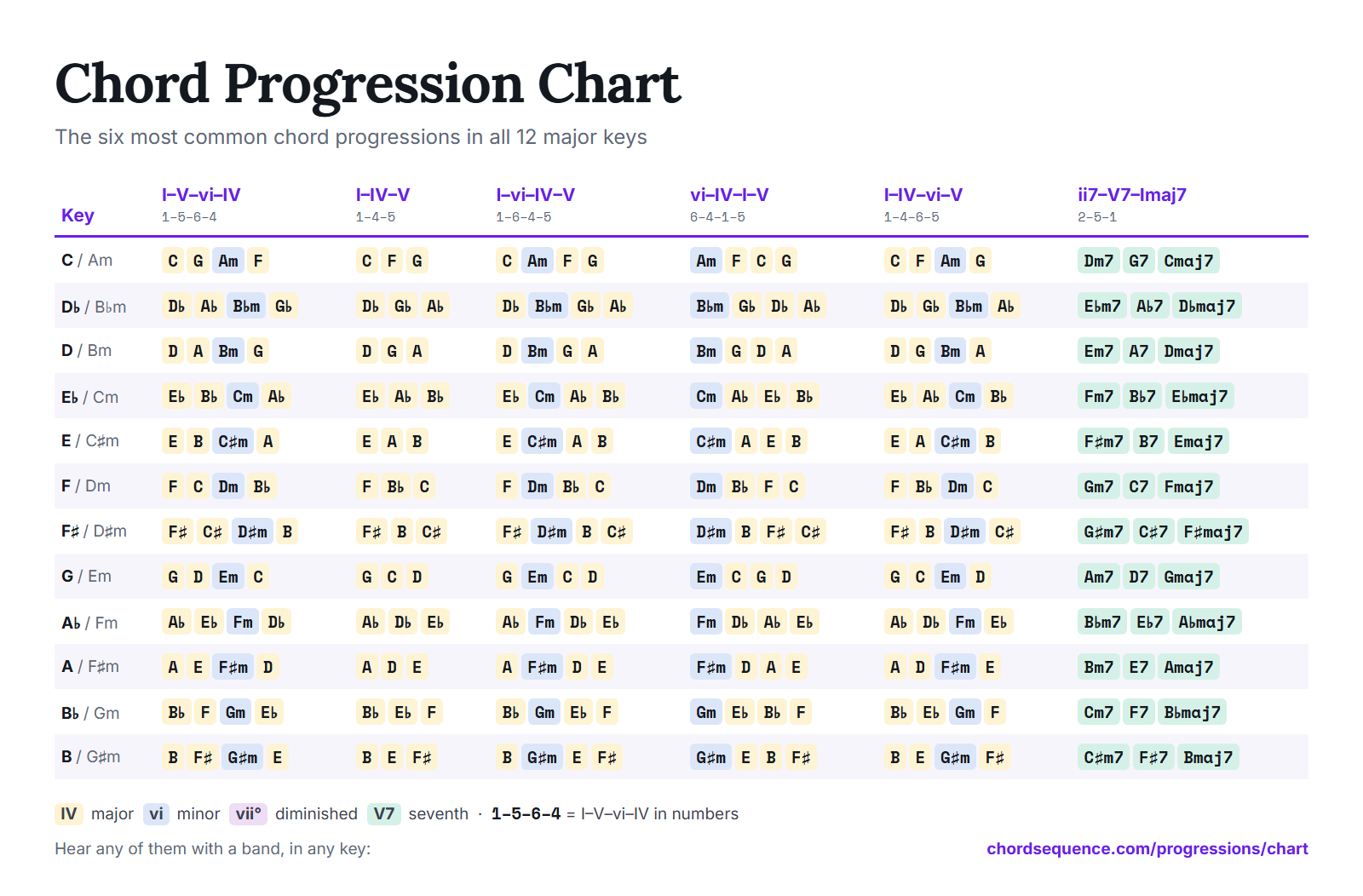
Chord progression chart
Every common progression in all 12 keys, major and minor. Free printable PDF.
iii → vi → ii / IV → V → I
Which chord comes next?
The progression map: tap a chord, hear what usually follows, build your own.
How to play them
I, IV, V and vi in every key on guitar, ukulele and piano.
More progressions to explore
Filter by genre, mood and key, then download free MIDI & WAV files for your DAW.
The Pop Axis Progression
The most popular harmonic sequence in modern music history. Driving, catchy, and instantly satisfying.
Heard in: Let It Be (The Beatles) · Don't Stop Believin' (Journey) · Someone Like You (Adele)
Major II–V–I Cadence
The cornerstone of jazz harmony. Creates smooth chromatic guide-tone voice leading and harmonic resolution.
Heard in: Autumn Leaves · Tune Up (Miles Davis) · Satin Doll (Duke Ellington)
Neo Soul Butter Groove
Lush, floating harmony with extended 9th and 7th voicings typical of D’Angelo, Erykah Badu, and Robert Glasper.
Heard in: Untitled (How Does It Feel) · Didn't Cha Know · Afro Blue
Lo-Fi Chillhop Loop
Mellow cycle with warm minor 7th colors designed for study beats, cozy rainy vibes, and relaxed head nodding.
Heard in: Coffee shop lo-fi playlists · Jinsang beats · Nujabes-style loops
Contemporary Worship Elevation
Dynamic anthem foundation for buildup from intimate acoustic verse into powerful, expansive choruses.
Heard in: Goodness of God (Bethel) · Holy Forever (Chris Tomlin) · What A Beautiful Name (Hillsong)
The Gospel 7–3–6 Turnaround
The move that defines the genre. E7♯9 is not in the key of C — which is exactly why it pulls so hard into the VI chord.
Heard in: Kirk Franklin arrangements · Fred Hammond turnarounds · Sunday-morning organ vamps
Browse by genre and mood
Every genre page has its own playable progressions, the theory behind them, and one-click export.
Diatonic Harmony & Tonalities
Interactive Harmonic Keys & Diatonic Chords
Select any key signature to inspect its 7 natural chords, relative minor, and iconic progression formulas with instant audio.
The 7 chords in C major
Natural (0 sharps / flats)Relative minor: A minor — the same seven chords, resting on VI instead of I.
Real-World Song Analysis & Stems
Iconic Song Chord Progressions
Listen to and analyze the harmonic loop behind well-known songs, then open the full chart or download MIDI & WAV stems for your DAW.
Total Praise
Richard Smallwood
Never Would Have Made It
Marvin Sapp
Autumn Leaves
Jazz Standard (Joseph Kosma)
Hallelujah
Leonard Cohen / Jeff Buckley
Goodness of God
Bethel Music / Jenn Johnson
Oceans (Where Feet May Fail)
Hillsong United
Theory Guide & Harmonic Composition
Why these progressions work
Practical harmonic theory for songwriters, producers, and beatmakers.
Tension and Resolution
Every chord in a musical key has an acoustic role: Tonic (stability and home), Subdominant (departure and gentle motion), and Dominant (peak harmonic tension pulling strongly back to tonic).
Smooth Transitions
Pro chord progressions minimize leaps between voices. By preserving common tones and stepping voices by semitones or whole tones, changes feel velvety, organic, and musically polished.
Borrowed Chords
Borrowing chords from parallel modes (like the famous minor iv in a major key, or ♭VI and ♭VII) injects instant nostalgia, emotional bittersweetness, and cinematic depth into any track.
Frequently Asked Questions About Chord Progressions
What is a chord progression?
A chord progression is a succession of two or more musical chords played in sequence. It forms the foundational harmonic bedrock for melody, bassline, and rhythm across every musical genre, creating emotional movement through patterns of tension and resolution.
What are the most famous and widely used chord progressions?
The most popular progressions include the Pop Axis progression (I–V–VI–IV, e.g., C–G–Am–F), the fundamental Jazz 2-5-1 cadence (II–V–I, e.g., Dm7–G7–Cmaj7), the 12-bar blues (I7–IV7–V7), the 50s Doo-Wop turnaround (I–VI–IV–V), and the cinematic emotional minor progression (I–VI–III–VII, e.g., Am–F–C–G).
How does Roman numeral analysis work?
Roman numerals represent the scale degree on which each chord is built (I, II, III, IV, V, VI, VII), regardless of key. Chord qualities and extensions (such as maj7, 7, m9, or diminished °) describe the exact voicing. This universal harmonic framework enables musicians to transpose and analyze harmony across all 12 musical keys effortlessly.
Can I export chord progressions and songs as MIDI and WAV files for my DAW?
Yes! You can export any progression or analyzed song on this page as both a standard MIDI (.mid) file compatible with any virtual instrument (VST/AU), and a WAV (.wav) audio stem ready to drag and drop into Ableton Live, FL Studio, Logic Pro, Cubase, Studio One, GarageBand, or Reaper.
Tools for working with progressions
- Chord Player Build your own progression and play it with a full band.
- Key detector Drop a song or type its chords and find the key.
- Chord transposer Move a whole progression to any key, with capo.
- Circle of fifths See which chords belong to each key, and why.
- Scales The scale to solo or sing over each progression.
Build your own progression
Use the Chord Player to arrange any of these chords, change the rhythm, and export MIDI or WAV.
Open Chord Player