
Quick answer
Pick four chords, give them a verse and a chorus, hum a melody over the loop, then fit your words to it. Write it down, play it back, and finish it.
Most guides to writing a song tell you what a verse and a chorus are, then leave you with a blank page. This one starts from the other end. You begin with four chords you can hear, and every step adds one piece until you have a song you can play back.
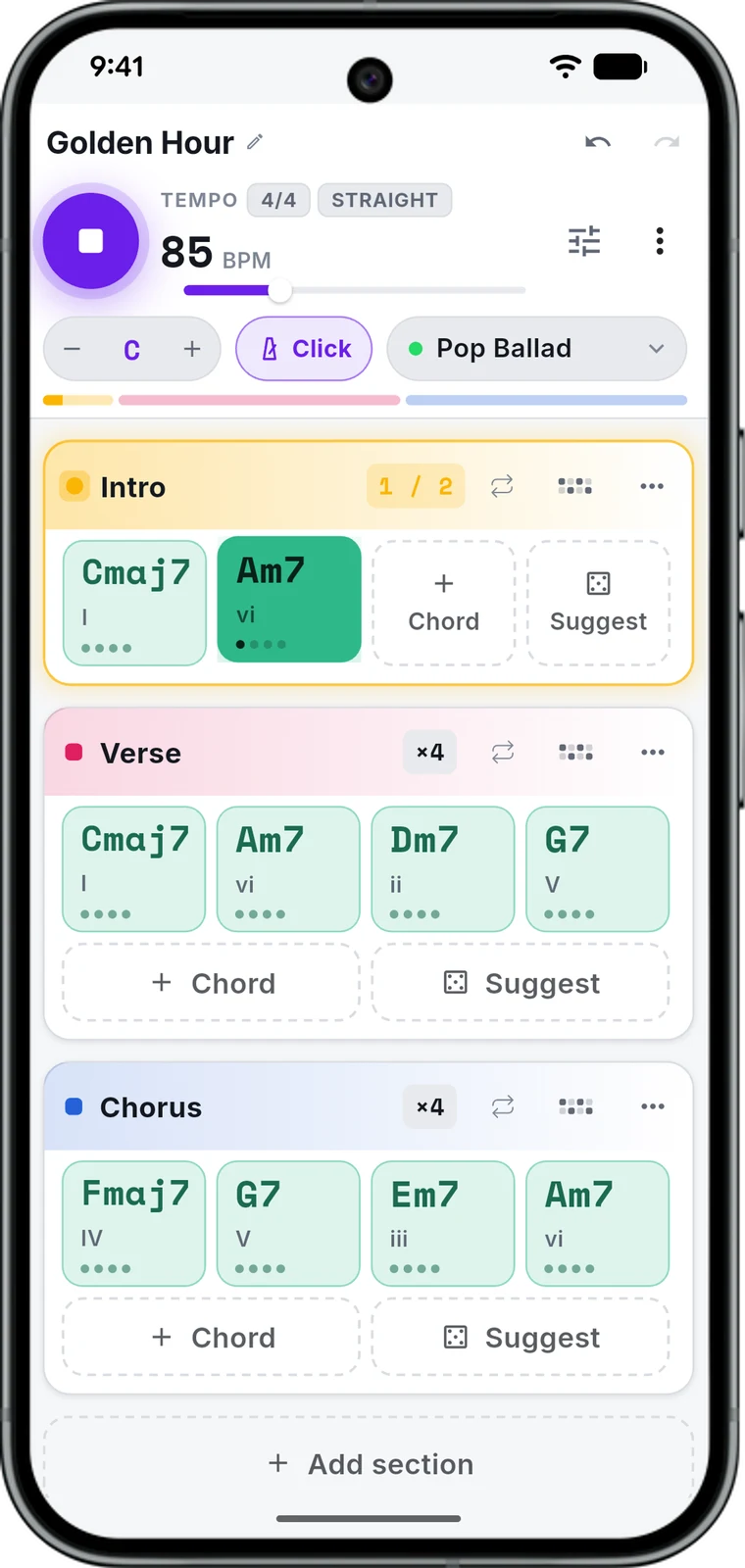
You don’t need to read music or play an instrument. The chord player in this guide plays the chords for you, and you sing or hum over them. If you do play guitar or piano, the same steps work and you can use your instrument instead.
Pick four chords you can sing over
A song needs something to stand on. For a first song, that is a chord progression: a short loop of chords that repeats. Four chords is plenty. Many well-known songs are built on three or four.
Press play on each progression below and keep the one that feels right. You can change it later. They are written in the key of C because it has no sharps or flats, which keeps the chords easy to read.
I–V–vi–IV (C, G, Am, F) is bright and familiar. It is the most used progression in pop.
vi–IV–I–V (Am, F, C, G) uses the same four chords but starts on the minor one, which makes it more emotional.
I–vi–IV–V (C, Am, F, G) is warm and nostalgic. It is the progression of the 1950s.
Want something even simpler? C, F and G are just three chords, and they are the base of the blues and early rock and roll. You can hear them in easy chord progressions for beginners. For more to choose from, the chord progressions table has eleven, in any key.
Give it a shape: verse, chorus, bridge
Most songs alternate two sections. The verse tells the story: each verse has different words over the same music. The chorus is the part people remember and sing back, with the same words every time. A bridge, usually once near the end, gives the song a change before the last chorus.
The most common shape is verse, chorus, verse, chorus, bridge, chorus. For the other forms and what the chords do in each section, see song structure explained.
- Intro
- Verse
- Chorus
- Bridge
Here is a trick that needs no new chords. Use the same four, but start the chorus on a different one. The verse starts on Am, which feels unsettled. The chorus starts on C, the home chord, and feels like arriving.
Hear the verse and the chorus back to back:
Real songs do this too. Song structure explained shows how the chords change between sections in songs from our library.
Find a melody by humming over the loop
Melody is the part nobody explains, so here is a method you can follow. Play your chords on repeat and work through four moves.
- Loop the chords. Play the four chords on repeat so you never have to stop and restart.
- Hum on “la”. No words yet. Hum whatever fits and record thirty seconds on your phone.
- Land on notes from the chord. On the first beat of each bar, aim for a note from the chord that is playing. Over C, that is C, E or G. Those notes always sound right.
- Repeat a short idea. Find three or four notes you like and repeat them, changing only the ending. Repetition is what makes a melody stick.
A melody over C · G · Am · F
4/4 · 100 BPM · key of C · 4 bars
- Note from the chord
- Passing note
- Notes of that bar's chord
Listen back to your recording and keep the parts you could hum again tomorrow. That is your melody.
Write the words to fit the music
Start with the chorus. Write one sentence about what the song is about, then turn it into a line you would not mind repeating. The verses come after, and they only have to explain the chorus.
Words need to fit the bars. As a starting point, put one syllable on each beat: a line of eight syllables then fills two bars of four beats. Sing it along to the loop.
Fit the words to the bars
Rhymes help a line feel finished, but not every line has to rhyme. Three patterns to try:
- AABB: lines one and two rhyme, then lines three and four. Easy to write and easy to follow.
- ABAB: the lines alternate, one with three and two with four. It feels more like a song.
- ABCB: only lines two and four rhyme. The loosest pattern and the most natural.
Write it down with the chords above the words
A chord sheet puts each chord exactly where it changes. It is how bands read a song, and it is the easiest thing to hand in, share or play from.
In the Chord Sheet Maker you write it as plain text. Put each chord in square brackets right before the syllable it lands on. A line with only a name, like Verse or Chorus, starts a new section.
You type
Verse
[Am]Streetlights hum a[F]long the road home
[C]Every window [G]glowing slow

Chorus
[C]We were never [G]lost, just learning
[Am]Every road still [F]leads back home
Put each chord in square brackets right before the syllable it lands on. A line with only a name starts a new section.
You get
Play it back, then finish it
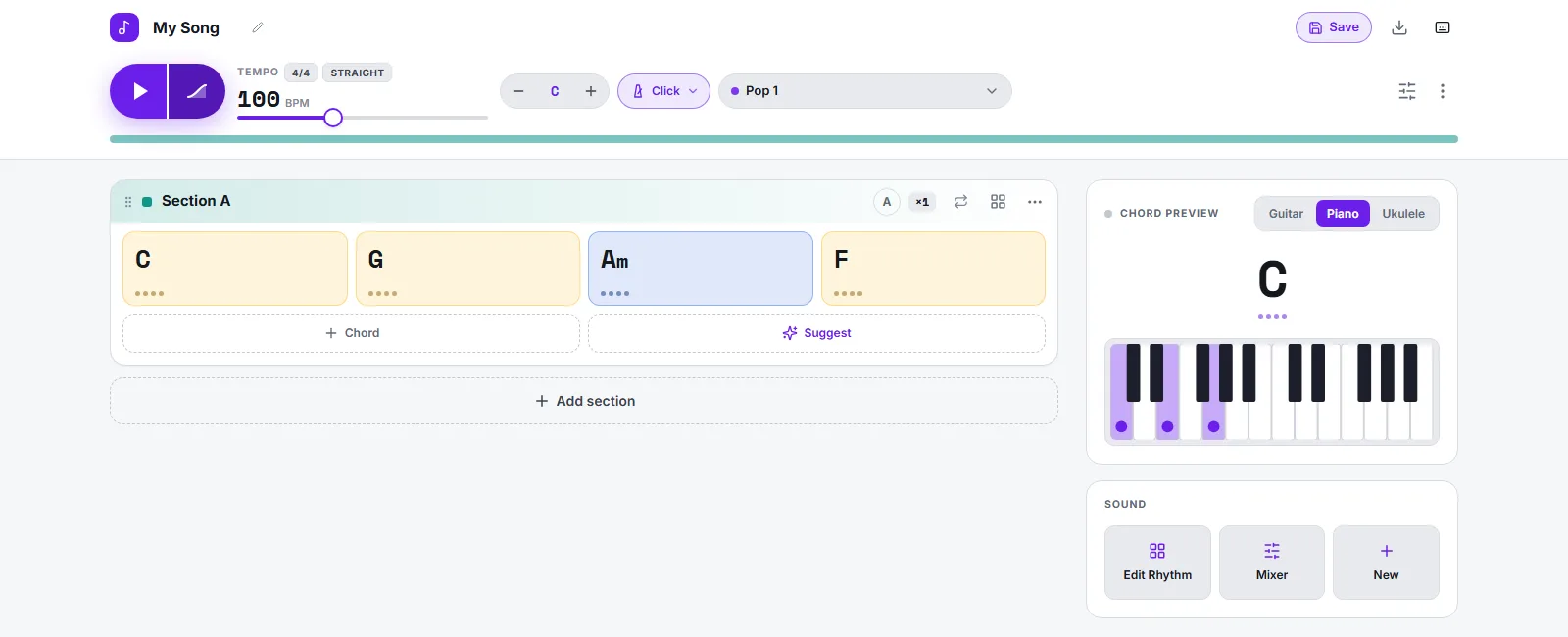
Build the same song in the chord player: add a section for the verse and one for the chorus, pick a sound and a tempo that suit it, and sing along. Record a rough take on your phone. A finished song that is a little rough beats a perfect first verse that never leaves the page.
You are done when:
- you can play it from start to finish without stopping,
- every line of the words fits the bars, and
- you have a recording, or a chord sheet someone else could play from.
From four chords to a finished song
Here is a whole short song built with the six steps. Play it, then change one thing at a time: the tempo, the sound, a word in the chorus.
Streetlights hum along the road home,
every window glowing slow.
I keep the tune I'm walking on,
just a few more miles to go.
We were never lost, just learning,
every road still leads back home.
Hold the light until it's morning,
sing it so you're not alone.
Five traps first songs fall into
| Trap | What to do instead |
|---|---|
| Using too many chords | Stay with four. A simple loop gives your melody room to be the interesting part. |
| Starting with a perfect first verse | Write the chorus first. It tells you what the verses need to explain. |
| Waiting for inspiration | Start with the loop and hum. A bad idea you can edit beats a blank page. |
| Rewriting the same line again and again | Finish a rough version of the whole song, then go back and improve it. |
| Never hearing it | Play it back after every step. If it does not sound right, you will know at once. |